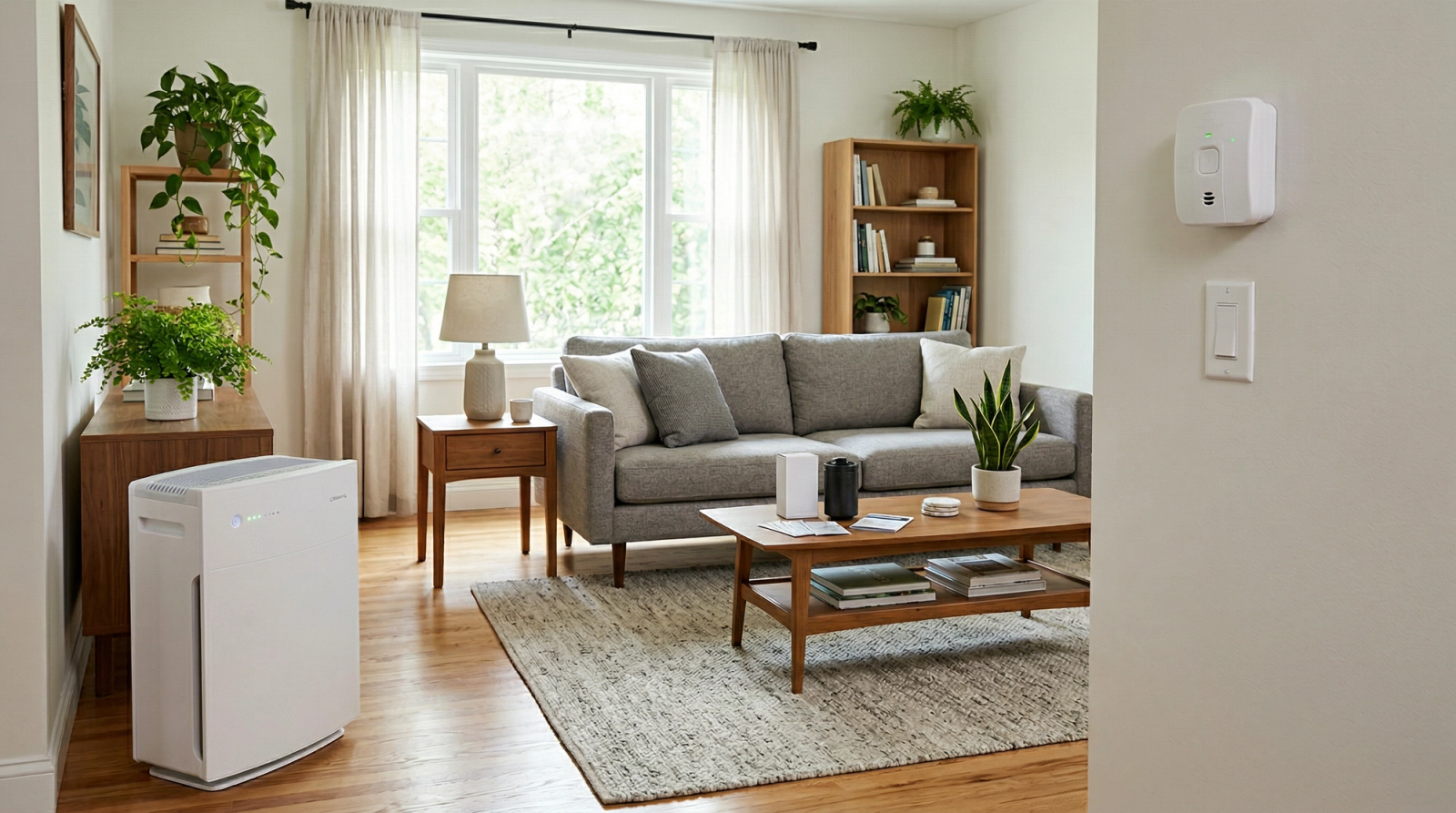
Air purifiers have become a staple in many households, and for good reason — they're highly effective at capturing airborne particles like dust, pollen, pet dander, and even some viruses. But a common assumption is that running an air purifier means your indoor air is fully protected. That's only partly true.
Understanding what air purifiers can and cannot do is one of the most practical things a homeowner can learn. When you know their limits, you can build a layered IAQ strategy that actually covers the full spectrum of indoor air threats — not just the ones a filter can catch.
What This Means for Your Home
Most air purifiers use HEPA filters, activated carbon, or a combination of both. HEPA captures particles down to 0.3 microns — excellent for dust, mold spores, and allergens. Activated carbon absorbs certain VOCs and odors. However, these technologies leave significant gaps. Radon gas, carbon monoxide, excess humidity, and many source-level pollutants pass right through or accumulate regardless of air filtration.
For homeowners, this means relying solely on an air purifier may give a false sense of security. A living room with a running purifier may still have elevated radon levels seeping up from the foundation, or CO quietly leaking from an attached garage. Addressing these requires separate detectors and source mitigation — not filtration.
What Science Tells Us
Research consistently shows that while HEPA filtration reduces fine particulate matter (PM2.5) effectively, it has no impact on gaseous pollutants like radon or carbon monoxide. The EPA notes that radon, a naturally occurring radioactive gas, requires specialized mitigation systems — ventilation and sub-slab depressurization — not air purifiers. Similarly, CO detectors are the only reliable way to identify carbon monoxide exposure since it's odorless and colorless.
Humidity is another dimension that filtration doesn't address. Relative humidity above 60% promotes mold and dust mite growth — conditions that produce the very particles air purifiers are meant to capture. Without a dehumidifier or proper ventilation managing moisture at the source, the filter is in a losing battle. Studies from Lawrence Berkeley National Laboratory confirm that source control consistently outperforms air cleaning for many pollutant categories.
Common Misunderstandings
One of the most widespread misconceptions is that an air purifier "cleans" the air completely. It reduces certain airborne pollutants — it doesn't eliminate all risks. Another common error is assuming that a purifier handles VOCs comprehensively. While activated carbon does absorb some VOCs, it has a saturation point and doesn't capture all chemical compounds equally. High-concentration sources like fresh paint, new flooring, or cleaning products can overwhelm any carbon filter.
People also often conflate air purifiers with air exchangers or ventilation systems. Purifiers recirculate and filter existing indoor air — they don't bring in fresh outdoor air. If your home is tightly sealed and CO2 levels are rising from occupants and combustion, a purifier does nothing to address that buildup. Ventilation — opening windows or running an ERV/HRV — is the solution for stale, CO2-rich air.
Practical Takeaways
Build a layered approach. Pair your air purifier with a CO detector, radon test kit (and mitigation if needed), a dehumidifier if humidity runs high, and adequate ventilation. Each tool targets different threats: the purifier handles particles and some gases; detectors handle safety hazards; dehumidifiers manage moisture-related growth; ventilation manages CO2 and dilutes indoor pollutants generally.
Also practice source control. The most effective strategy is preventing pollutants from entering your air in the first place — choosing low-VOC paints and flooring, maintaining combustion appliances, sealing foundation cracks, and keeping indoor humidity in the 30–50% range. An air purifier is a valuable last line of defense, not a first.
Bottom Line
Air purifiers are a genuinely useful tool in your indoor air quality toolkit — just not the only tool. They excel at reducing particulate matter and certain gaseous pollutants, but they can't address radon, CO, humidity imbalances, or CO2 buildup from inadequate ventilation. Knowing these limitations helps you spend wisely and build a complete strategy that keeps every corner of your home's air genuinely safe.
Frequently Asked Questions
Can an air purifier remove radon from my home?
No. Radon is a radioactive gas that requires specialized mitigation — typically sub-slab depressurization systems installed by a certified contractor. Air purifiers cannot capture or neutralize radon gas.
Will an air purifier help with carbon monoxide?
No. CO is a gas that passes through HEPA and most carbon filters. You need a dedicated CO detector. If CO is detected, identify and fix the source immediately — this is a safety issue, not an air quality one.
Does an air purifier reduce humidity or mold?
An air purifier can capture airborne mold spores, but it won't lower humidity or address the moisture source fueling mold growth. A dehumidifier and source control are needed to prevent mold from recurring.
Can I rely on my purifier to handle VOCs from new furniture or paint?
Only partially. Activated carbon filters absorb some VOCs, but high-concentration off-gassing from new materials can exceed filter capacity. Ventilate heavily during and after installation to dilute VOCs at the source.
Want to improve your home's air quality?
Take our comprehensive air quality quiz to get personalized recommendations.
Take the Quiz