Introduction
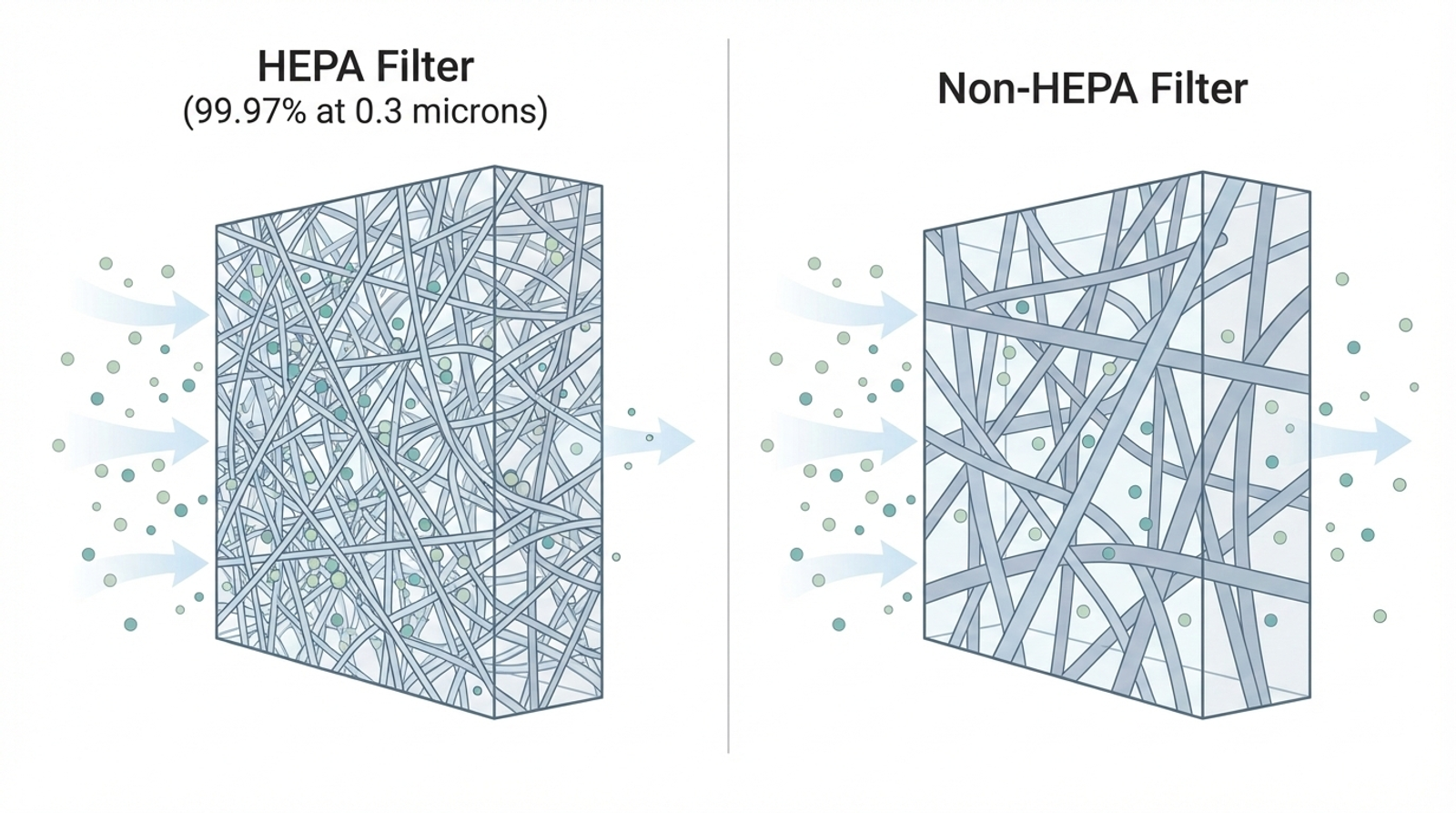
If you’re comparing HEPA vs. non-HEPA filters, the short answer is this: HEPA filters remove far more fine particles from indoor air, but they aren’t always necessary—or practical—for every home.
In most homes we assess, the right filter choice depends on what you’re trying to remove (dust, smoke, allergens), how the system is used (HVAC vs. portable purifier), and how well the home is maintained overall. Marketing labels can make this confusing, so this guide breaks it down in plain language.
We’ll explain what HEPA really means, how non-HEPA filters perform in real homes, and how to choose the right option without overspending or overcomplicating things.
What This Means for Your Home
From real-world indoor air quality assessments, homeowners commonly notice that:
- Dust and pet hair improve with almost any upgraded filter
- Smoke, fine particles, and allergy symptoms improve much more with HEPA
- The “best” filter on paper can fail if airflow, sealing, or maintenance are poor
The goal isn’t just a better filter—it’s cleaner air where you actually live and breathe.
What Is a HEPA Filter?
A HEPA (High-Efficiency Particulate Air) filter is certified to capture at least 99.97% of particles as small as 0.3 microns.
That includes:
- PM2.5 (fine particulate matter)
- Pollen
- Pet dander
- Mold spores
- Smoke particles
In most homes we see, HEPA filters are used in:
- Portable air purifiers
- Whole-home systems with dedicated HEPA housings (less common)
Important: “HEPA-type” or “HEPA-like” is not the same as true HEPA.
What Are Non-HEPA Filters?
Non-HEPA filters include:
- Fiberglass filters
- Pleated HVAC filters
- Electrostatic filters
- Washable/reusable filters
These filters are usually rated using a MERV rating (Minimum Efficiency Reporting Value).
Typical performance:
- MERV 1–4: Captures large dust only
- MERV 5–8: Better for dust and pollen
- MERV 9–13: Can capture some fine particles
In many homes, a MERV 8–11 HVAC filter strikes a good balance between airflow and filtration.
Symptoms That May Point to the Right Filter Choice
In most homes we see, these patterns are common:
HEPA may be helpful if you notice:
- Allergy or asthma symptoms indoors
- Smoke odors or wildfire haze
- Fine dust settling quickly after cleaning
Non-HEPA may be sufficient if:
- Dust is the main issue
- You want basic HVAC protection
- No sensitive occupants are present
Conclusion
When it comes to HEPA vs. non-HEPA filters, the right choice depends on your home, your health priorities, and how the filter is used. HEPA filters excel at removing fine particles, while non-HEPA filters provide practical, affordable baseline protection.
In most homes we evaluate, combining smart filter selection with proper maintenance delivers the biggest improvement in indoor air quality—without unnecessary upgrades.
Common Causes of Confusion
- Assuming all “HEPA” labels mean certified HEPA
- Expecting HVAC filters to perform like air purifiers
- Ignoring airflow restrictions
- Skipping regular filter changes
A clogged or mismatched filter often worsens air quality, even if it’s technically “better.”
How to Fix or Improve Indoor Air Quality (Step-by-Step)
- Identify the problem
- Dust, smoke, allergies, odors, or all of the above
- Choose the right tool
- HVAC filter for whole-home baseline control
- HEPA air purifier for targeted rooms
- Check airflow
- Ensure HVAC systems can handle higher MERV ratings
- Seal and maintain
- Replace filters on schedule
- Ensure purifier filters fit tightly
- Verify results
- Many homeowners confirm improvement with a PM2.5 monitor
Professional Insight: When to Bring in an Expert
Consider professional help if:
- Symptoms persist despite filtration upgrades
- Mold or moisture is suspected
- HVAC airflow issues appear after filter changes
In many assessments, filtration alone doesn’t solve issues tied to leaks, humidity, or ventilation problems.
Prevention Tips
- Replace HVAC filters every 1–3 months
- Avoid washable filters unless properly maintained
- Don’t oversize HEPA purifiers for small rooms
- Pair filtration with good ventilation when possible
People Also Ask: Quick Answers
Are HEPA filters always better than non-HEPA?
No. HEPA is best for fine particles, but non-HEPA filters work well for basic dust control and HVAC protection.
Can I put a HEPA filter in my HVAC system?
Usually not without a dedicated HEPA housing. Most HVAC systems aren’t designed for HEPA resistance.
Do HEPA filters remove odors?
Not by themselves. Odors require activated carbon or other gas-phase filtration.
Is MERV 13 the same as HEPA?
No. MERV 13 captures many small particles but does not meet HEPA’s efficiency standard.
Frequently Asked Questions
What filter is best for allergies?
HEPA air purifier in bedrooms plus a MERV 8–11 HVAC filter works well in most homes.
Do non-HEPA filters help with smoke?
Only slightly. HEPA filters are far more effective for smoke particles.
How often should filters be replaced?
HVAC filters: every 1–3 months. HEPA filters: typically 6–12 months, depending on use.
Are expensive filters always better?
No. Fit, airflow, and maintenance matter more than price.
Can filtration fix mold problems?
No. Filtration can reduce spores, but moisture issues must be addressed directly.
Want to improve your home's air quality?
Take our comprehensive air quality quiz to get personalized recommendations.
Take the Quiz