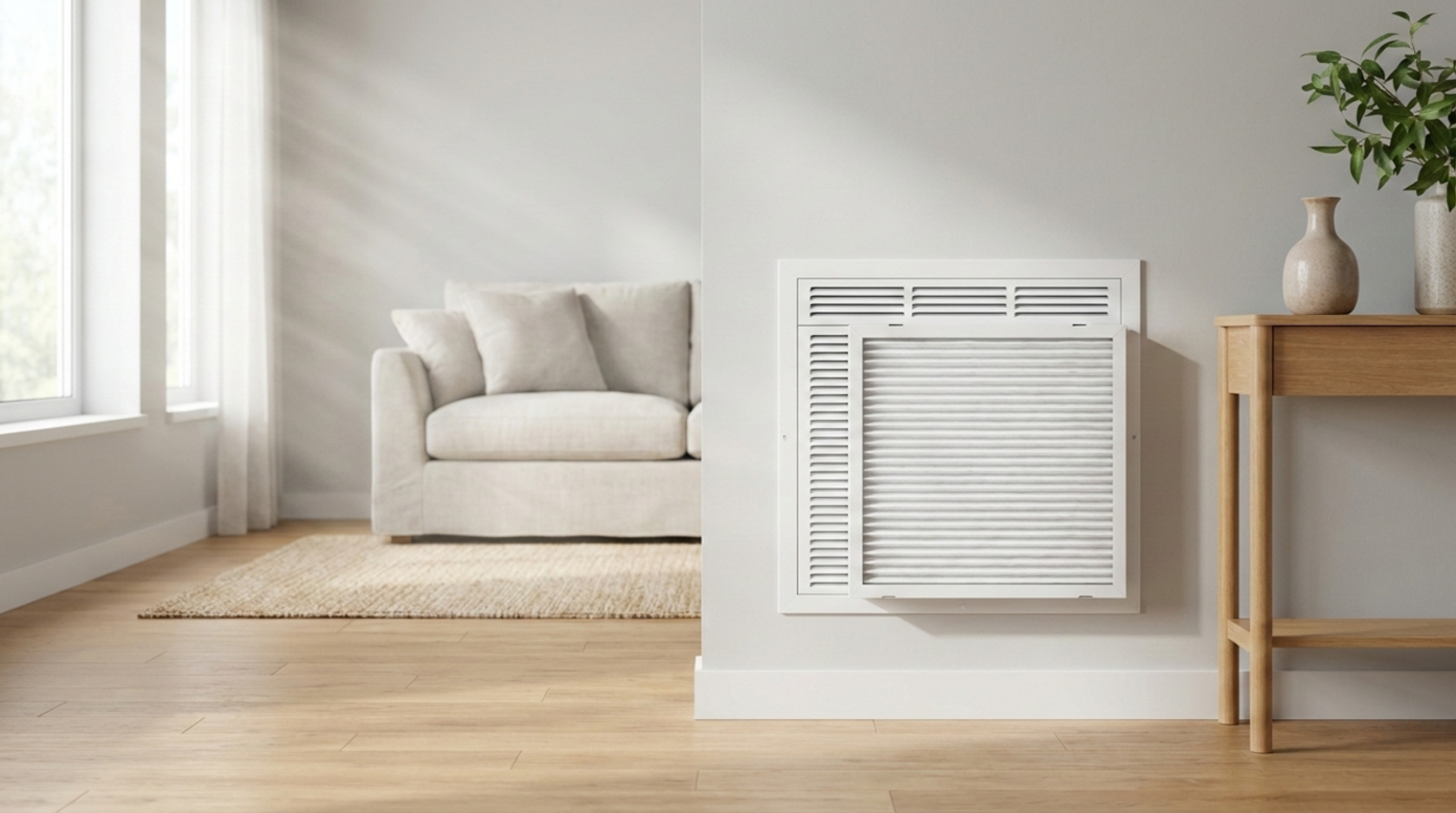
The best MERV rating for most homes is MERV 8 to MERV 13, depending on your HVAC system and indoor air quality goals. Higher isn’t always better—choosing the right MERV rating is about balancing filtration and airflow, not just trapping the smallest particles.
In most homes we assess, homeowners want cleaner air for allergies, dust, or wildfire smoke—but don’t realize that using a filter that’s too restrictive can actually reduce system performance.
This guide explains which MERV rating is best, how to choose the right one for your home, and what we commonly see during real-world indoor air quality assessments.
What This Means for Your Home
Your air filter affects more than dust—it directly impacts:
- How clean your indoor air is
- How hard your HVAC system works
- Energy use and system lifespan
Homeowners commonly notice that after switching filters, rooms feel stuffy, airflow drops, or the system runs longer. In many cases, the issue isn’t the HVAC system—it’s the wrong MERV rating.
Symptoms, Signs, or Indicators You’re Using the Wrong MERV Rating
In homes we evaluate, these signs often point to a mismatch:
- Weak airflow from vents
- Hot or cold spots in certain rooms
- HVAC system running longer than usual
- Filters clogging quickly
- Whistling or suction noises at return vents
If these appear shortly after installing a higher-rated filter, the MERV level may be too high for your system.
Common Causes of Confusion Around MERV Ratings
- Assuming higher MERV = always better air
- Not accounting for older HVAC systems
- Confusing hospital/commercial standards with residential needs
- Ignoring filter thickness (1” vs 4–5” media filters)
MERV ratings measure particle capture, not overall system performance.
How to Fix or Improve It: Choosing the Right MERV Rating
Step 1: Understand MERV Basics (Plain Language)
MERV (Minimum Efficiency Reporting Value) rates how well a filter captures particles like dust, pollen, and smoke.
- Higher MERV = captures smaller particles
- Higher MERV = more airflow resistance
Step 2: Use This Homeowner-Friendly MERV Guide
MERV 6–7
- Basic dust protection
- Not ideal for allergies
- Often used in older systems
MERV 8 (Most Common Recommendation)
- Traps dust, pollen, pet dander
- Minimal airflow impact
- Best “safe default” for most homes
MERV 11
- Better for allergies and finer particles
- Requires a reasonably strong HVAC blower
- Common in newer homes
MERV 13
- Captures smoke, bacteria, fine PM2.5
- Excellent for wildfire smoke or respiratory concerns
- Best with modern systems or thick media filters
In most homes we see, MERV 8 or MERV 11 delivers the best balance.
Step 3: Match the Filter to Your System
Ask yourself:
- Is your system older than ~15 years? → Stay ≤ MERV 8
- Do you have allergies or pets? → MERV 8–11
- Concerned about wildfire smoke or PM2.5? → MERV 11–13 (if system allows)
If you’re using a 1-inch filter, be especially cautious with MERV 13.c
Conclusion
So, which MERV rating is best?
For most homes, MERV 8 or MERV 11 delivers the best balance of clean air, airflow, and HVAC health.
Higher isn’t automatically better. The right MERV rating is the one your system can handle consistently—while still improving indoor air quality.
At HomeAirIQ, we focus on real-world performance, not just specs.
Professional Insight: When Experts Should Get Involved
During in-home assessments, we often measure static pressure to see how restrictive a filter really is. If:
- Your system overheats
- Airflow is inconsistent
- Filters clog in under 30 days
An HVAC professional or indoor air quality specialist should evaluate whether your system can safely handle a higher MERV rating.
Prevention Tips
- Change filters every 1–3 months
- Never “stack” filters
- Don’t upgrade MERV ratings without monitoring airflow
- Consider 4–5 inch media filters if upgrading filtration
- Pair filtration with ventilation—not filtration alone
People Also Ask: Quick Answers
Is MERV 13 too high for a home?
Not always. In most modern homes, MERV 13 works well if airflow is designed for it. Older systems may struggle.
Is MERV 8 good enough?
Yes. In most homes we assess, MERV 8 provides meaningful air quality improvement without stressing the system.
Does higher MERV remove viruses?
Higher MERV filters can capture virus-sized particles when attached to larger droplets, but they are not a replacement for ventilation or air purifiers.
What’s better: MERV 11 or MERV 13?
MERV 11 is often the safer upgrade. MERV 13 offers better filtration but requires system compatibility.
Frequently Asked Questions
How often should I replace a high-MERV filter?
Typically every 1–2 months, depending on dust load and pets.
Do thicker filters work better?
Yes. Thicker filters reduce airflow resistance while maintaining filtration.
Can a high MERV filter damage my HVAC system?
Yes—if airflow drops too low, it can shorten system life.
Is MERV rating the same as HEPA?
No. HEPA filters are far more restrictive and usually require separate systems.
Should renters use high MERV filters?
Usually MERV 8 is safest unless the landlord confirms system specs.
Want to improve your home's air quality?
Take our comprehensive air quality quiz to get personalized recommendations.
Take the Quiz